Physical Development (PD)
The Physical Development (PD) domain assesses motor development progression, including perceptual-motor skills and movement concepts, gross locomotor movement skills, gross motor manipulative skills, fine motor manipulative skills, and active physical play.
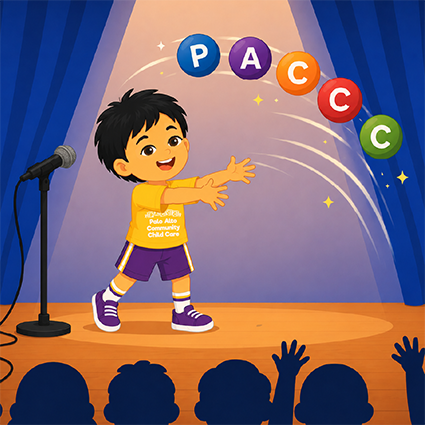 Meet Kai Ryder,
Ambassador for Physical Development!
Kai Ryder was so excited to be the Ambassador for Physical Development with the honor of addressing their fellow classmates, they could not help but do a fancy summersault on the way to the podium!
Weee! One, two, and three roll ‘em summersaults with a perfect landing at the podium! Wow! The crowd cheered and just for a moment, Kai imagined what it would be like to be an Olympian! Kai could see it all so clearly in their mind – the jumping, the rings, the balance beam…more jumping, more running…taking home the gold!
Kai was very active and the ideal person for the Physical Development Ambassador role. Kai had been practicing summersaults for as long as they could remember. Kai’s mom had joked once that when Kai was an infant-toddler, they went from crawling on the side of their crib to pole-vaulting and doing cartwheels with a baby bottle in one hand. That’s just silly, thought Kai.
Kai stepped up to the mic, leaned in and said, “My fellow Olympians…Oops! I mean, my fellow classmates, I am Kai Ryder, Ambassador for Physical Development! Today, we’re going to learn about our motor skills: Perceptual motor skills, gross motor skills – but not the kind of gross like when your baby brother spits out his food, and…fine motor skills."
“When we do summersaults, or when we run and jump, those are called gross motor skills because we are using big muscles to move our bodies.”
Kai struck a funny pose to show off their muscles, which were um, still in development. The children all copied the pose to show off muscles that weren’t exactly there yet, but well on their way. Even the teachers and parents joined in and struck a pose!
Then Kai took 5 balls out of their pocket, each embossed with a letter to spell out ‘P-A-C-C-C’ and held each one up for the audience to see. “First, I’m going to demonstrate fine motor skills, by using the small muscles and tendons in my hands to autograph these! And then if I become a famous baseball player, I’ll already know what to do,” laughed Kai.
Kai signed the balls quickly and confidently and it did seem like maybe they would become a professional baseball player one day. Anything is possible! Then, with a mischievous smile, they gently tossed the balls out into the audience and yelled, “Catch!”
The audience laughed and jumped, and dove for the balls, all holding their ‘catch’ like a trophy as Kai completed the physical development lesson by saying, “And catching those balls is an example of perceptual motor skills that we can all do on the playground during…you guessed it – recess!”
“RECESS!” the kids cheered.
“Thank you for being a great audience with some impressive motor skills and see you on the playground!”
The End.
(When we use the phrase ‘the end,’ we mean a bend towards the end, which like time, repeats itself and begins again. You should probably return here for more stories!)
Physical Development Progression
|
Infant-Toddler |
Preschool |
School-Age |
|
|
Perceptual Motor Skills |
Kai crawls up the ramp onto the platform and sits at the top and looks around the classroom. |
Kai is playing tag with friends and maneuvers through the play structure without bumping into the slide or poles. |
Kai has learned to ride a bicycle without training wheels during bike day at school. |
|
Gross Motor Skills |
Kai uses a push toy to walk around the classroom. |
Kai climbs the stairs of the play structure and then slides down the slide. |
Kai plays hop scotch with their friends during recess. |
|
Fine Motor Skills |
Kai holds stacking rings and places them on the post. |
Kai uses a rolling pin and cookie cutters to flatten out the playdough. |
Kai builds a house using small lego pieces. |